Announced as part of the 2025 Budget, businesses can now deduct 20% of the value of new assets from taxable earnings. This applies to machinery, plant, and importantly for building owners, improvements to depreciable property. Now may be a good time to extend that warehouse, upgrade the facade of your office block, or to undertake seismic strengthening.
Are you a building owner who wants to protect your investment but finds it difficult to navigate %NBS and what your responsibilities are? Matt Pfahlert, Structural Engineer, breaks down the seismic assessment process and discusses the assessment and strengthening of commercial buildings.
Navigating the bureaucratic maze
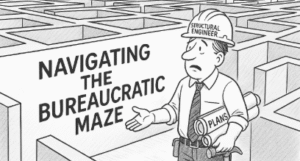
IEP, DEE, ISA, DSA, %NBS.
If you are confused by the alphabet soup, you are not alone. The ever-changing rules for assessing and strengthening existing commercial buildings are difficult to navigate, but here at EDC we have the expertise to assist you.
So, what are your requirements by law if you own a commercial building that may be earthquake-prone?
If you haven’t been assessed as potentially earthquake prone, in short, there are no requirements. It is up to the local territorial authority (the Council) to identify potential earthquake-prone buildings in their district. This may occur due to the building being high profile, or historically significant. It may also occur if you apply for a building consent or propose a change of use. If a territorial authority identifies your building as potentially earthquake-prone, they will inform you and request that you undertake an engineering assessment. This must be completed within 12 months after the date of the request. Alternatively, you can simply accept the earthquake prone assessment, with the Council adding the building to the earthquake prone building register (https://epbr.building.govt.nz/).
What kind of assessment do you require?
EDC has undertaken many assessments on a wide range of building types and sizes. There is no one size fits all, but broadly, we can complete an Initial Seismic Assessment (ISA – previously known as an IEP) or a Detailed Seismic Assessment (DSA – previously known as a DEE). There is an element of getting what you pay for. While the initial seismic assessment is cheaper, it is a crude assessment tool that mainly considers a building’s age. If you truly want to know what %NBS your building is at and how it will perform in a big shake, a DSA is the only way to go.
I’ve completed my assessment, and it has been indicated that my building is potentially earthquake-prone, what do I do now?
Following a detailed assessment being completed, if any of the building elements are rated below 34% NBS, the building may be considered earthquake prone. We stress that this may not mean you own a dangerous building, and this is a reason why we recommend you engage with a structural engineer to complete a DSA which will highlight any elements which may be considered structural weaknesses.
A structural engineer DOES NOT deem a building to be earthquake prone. We are only able to complete the assessment which is ultimately provided to the local territorial authority who can classify a building as earthquake prone and issue an EPB notice. If your building is issued an EPB notice and placed on the EPB Register you have 15, 25 or 35 years to fix or demolish the building if you are in a high, medium or low seismic risk area respectively. High risk areas include bustling cities like Christchurch, Wellington and Palmerston North. This is the one occasion where being from Auckland is a positive thing – you will have 35 years following issue of an EPB.
Is this deadline definitive?
Well, no – not really. Recently an extension was granted, which gave a four-year extension to building owners who had been issued an EPB notice that had not lapsed prior to 2 April 2024. There are at least 5000 buildings that have been deemed as earthquake prone to date, which means this is something you need to be thinking about.
My building has been classed as earthquake-prone, what now?
You will already hopefully be in contact with a structural engineer who will be able to produce calculations and drawings for your target strengthening. All strengthening will require a building consent or building consent exemption.
For strengthening, a target of 70% NBS is generally favoured by banks and insurance companies, and your structural engineer will be able to advise if it is possible to go further. It may not cost as much as you think – we have been involved in projects where earthquake prone buildings have been strengthened to 70% NBS+ for a fraction of the value of the property.
What should I look for in an engineer?
We recommend that you look for an engineer who will take a practical approach towards strengthening to understand your building. Seismic strengthening is not simply a case of following rinse and repeat details, the best strengthening will be bespoke to your building. Strengthening must take into consideration the existing (and proposed) use of the building, practicality to install and of course cost.